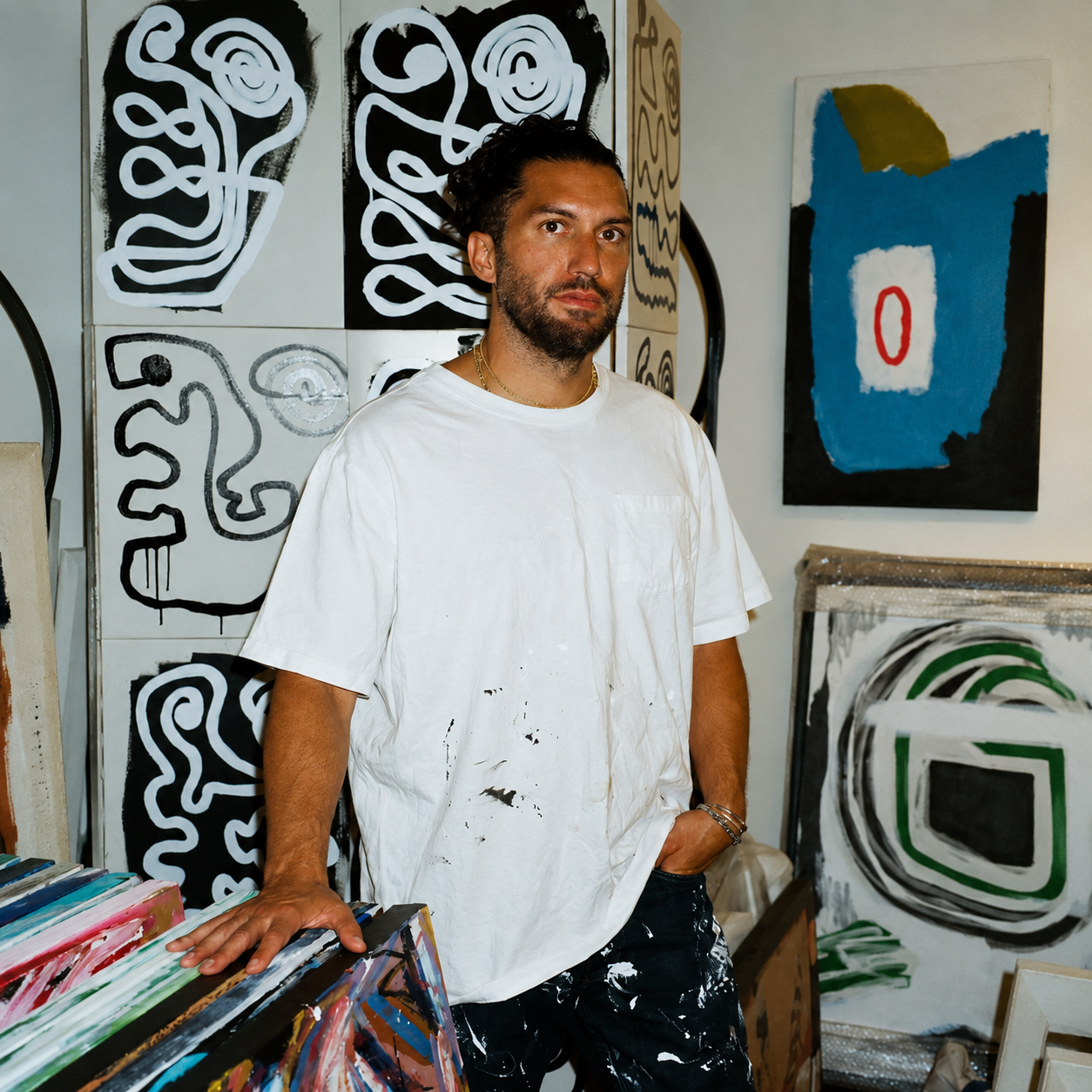
A Dialogue Between Collector and Artist
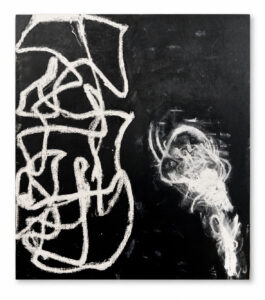
Chalk Against Night, 2025
Acrylic and oil stick on canvas
64 × 57 in (163 × 145 cm)
Courtesy of the artist
Paul Scribner · The Left Side of the Canvas | Dominic J. Lopez · Returning to the Painting
The Left Side of the Canvas
A letter to Dominic J. Lopez
22 September 2026
Dominic,
You wrote that the difficulty is not making the work, but in remaining psychologically available to it while time unfolds. I have read that sentence more times than I would admit to anyone but you, and I want to tell you what it looks like from where I sit, which is not a studio. I would not use your phrase for it; I would say staying in the room. But it is the same thing, and you got there first.
I hold paper. Notes, contracts, positions in companies, claims that are worth something only if the other side performs. Some of it I originated, some of it I inherited from decisions that seemed better at the time. All of it has one thing in common with the left side of your canvas. It is a mark that has to be laid down again and again before anyone can tell whether it held.
People imagine that the hard part of holding a position is the day it goes wrong, but it’s not. The day it goes wrong is loud, and loud is easy. There are calls to make and lawyers to instruct and a story that everyone can follow.
The hard part is the twenty-third month.
It looks like this: a statement arrives with the same number on it as last month. An email arrives from the other side, two lines, courteous, answering nothing. You read it at a red light, and then again in the car park. Then you go into a meeting about something else and do not hear the first ten minutes of it. Nobody asks you about the position anymore. That is the whole day. There will be another like it in thirty days.
By then the thing you are holding has stopped producing anything you can point to. The counterparty has gone quiet or has become polite in the way people become polite when they no longer intend to pay. The people who told you to get out have stopped telling you, because they have stopped thinking about it, their silence worse than their advice. The position sits on a page with a number next to it that has not changed, and every month you are asked, by a bookkeeper or a board or yourself, whether that number is still true.
The question arrives monthly. This is the part that I think your essay understood and most writing about persistence does not. Persistence is described as a quality. It is actually a schedule.
I will keep what follows at the level of pattern, because the particulars belong to other people. This is the cost of holding.
It costs cash, obviously, but cash is the least of it. Cash is a number. You can look at a number.
It costs attention, and attention is the thing nobody accounts for. A position that is not performing takes more of your mind than one that is. It consumes attention that should belong to other work, and no ledger I have ever seen has a line for that.
It costs the offers you decline. Somewhere in the second year someone will offer to take the thing off your hands. The number will be low and the relief will be high, and the person offering will be sincerely surprised that you are not grateful. Declining is not a single act of will, but a standing instruction to yourself, renewed every time the offer resurfaces in a new form. (It resurfaces more often than you would think.)
It costs the story. For as long as the return is not visible, you are the person who is still in something that everyone else got out of. You cannot explain why without sounding either stubborn or naive, so you stop explaining. The position becomes something you carry privately. Your essay had a line about the years that do not make it into the story. I would add that the reason they do not make it in is that you learn to stop telling them.
And it costs the belief. Not all at once. A little less each month, as you put it. What I have noticed is that belief does not need to be replaced at the same rate it leaks. It needs to be replaced only enough that the next month’s decision can be made. That is a lower bar than people think, and it is the bar that matters.
I want to draw one distinction, because I think it is the practical heart of your question.
Waiting is passive. It is what you do when the outcome is out of your hands and you have made peace with that. Holding is not passive. Holding is a decision that has to be remade on a schedule, with the same information as last time plus one more month of nothing.
It is also not the refusal to change your mind. It is the obligation to make the decision again, on the facts as they stand now. If the thesis has changed, the decision should change with it. A holder who can no longer say why he is still in is not holding. He is stuck, and the two look identical from the outside for a long time.
The people I have watched leave a position usually did not decide to leave. They stopped deciding to stay. There is a difference, and it is the whole difference. One month the decision was not made, and the absence of a decision became the decision. Your right-hand mark looks like that to me. Not erased or rejected. Simply not laid down again.
You asked what allows one person to remain devoted for fifty years while another leaves after five. I do not know either, and I am suspicious of anyone who says they do. But I can tell you what I have observed on the paper side of the table, and it is narrower than an answer.
The ones who stay had decided earlier what the position was for. Not what it would return, but what it was for. When the return went dark, they still had the earlier thing, and the earlier thing did not depend on the monthly number.
They had also priced the cost before it arrived. They were not surprised by the twenty-third month. They did not enjoy it, but they already knew it would happen.
The ones who left are harder to generalise about, and I want to be careful here, because some of them were right. Some had re-underwritten and found the thesis gone, and left on that, and that is not the right side of your canvas. That is a decision. But the ones I am describing were often more talented and better capitalised than the ones who stayed, and what they had in common was that they left at the exact moment the cost became legible. Until that moment they had not known there would be one. The position had been about the return, which is a perfectly reasonable way to hold a position and a poor way to keep one.
And the ones who stay, I have noticed, are rarely the ones who talk about staying. It is not a posture for them. It is a Tuesday.
One entry from the ledger, without a name.
A man held paper on me once, during a period when the return on that paper was not visible and would not be for some time. He had every right to call it. It would have been the reasonable course, the one his advisers would have recommended, the one that would have looked prudent on his own books.
He did not call it. He did not tell me he was not calling it, he simply did not, month after month, while I did what I could to make the number true again. I learned later, from someone else, that it had cost him something to hold, and that he had held anyway.
I think about him when I read your sentence about the people who stay in relationship with the thing they love. He was not in relationship with my paper. He was in relationship with something else, some earlier decision about what kind of creditor he chose to be, month after month, and the paper was only where that decision happened to land. That is how I read the left side of your canvas. Something was settled before the first pass, and the paint is the record of it being settled again.
You wrote that wealth explains runway and not devotion, and then said you found the explanation unsatisfying. I want to add one observation from my side, because I think you were right to be unsatisfied.
Runway buys months, but it does not buy the decision that has to be made in each of them.
I have also seen the opposite of the usual assumption. Capital sometimes makes leaving easier rather than staying easier. A party that can absorb the loss and be somewhere else by the following quarter will often do exactly that, not because the position was wrong but because the exit was cheap. And I have watched people with no runway stay because leaving was not affordable, and a few of them, not all, found somewhere in the staying the thing you called devotion. I do not want to make a law of that. Lack of capital forces capitulation at least as often as it forces anything else, but the direction is not as one-way as the usual assumption has it.
You wondered whether certain environments create an instinct that comfort never could. I cannot say. What I can say is that the absence of an alternative is a test, and the presence of one lets a person skip it. What allows someone to sit a test they could have skipped, I do not know.
I said in my note that neither of us has to explain the right side of your canvas. I will keep to that. But I will say what it looks like from here.
It is not a failure. It is not even a decision. It is a mark that was laid down once, and it was a real mark, and you can still see where it was. Somebody was in the room for a season. Then one month the mark was not laid down again, and the reasons, as you said, made perfect sense at the time.
I have been that mark. I expect you have too. Nobody holds everything.
What I keep coming back to is that both sides are the same material, on the same black, by the same hand. Whatever separates them is not talent, and it is not money. I used to think it was character. I am less sure of that than I was. It may be nothing more than that the decision got made one more time than it did not, and nobody, including the person making it, could have told you in advance which month that would be.
You answer, or you do not. Either way, the painting is still on the wall, and I am still looking at the left side of it.
Paul
Dubai, September 2026
Returning to the Painting
Dominic J. Lopez
In response to Paul’s The Left Side of the Canvas
5 October 2026
When I wrote While Time Unfolds, I kept thinking about a woman I had watched enter a sauna in Barcelona. She had to be 100 years old. She stood from her wheelchair with help and slowly made her way into the heat. She stayed while others came and went.
What moved me was her willingness to participate in the day in front of her. The willingness was visible, but the explanation was not.
Paul’s The Left Side of the Canvas brings the question into the twenty-third month of holding a position. The number is unchanged, the courteous email answers nothing, and another decision has to be made without reassurance of success. “Persistence is described as a quality. It is actually a schedule.” His sentence gives the question a practical weight. Whatever brought someone this far has to survive an ordinary month.
A schedule can bring me back to the studio, but once I am there, I still have to look. That becomes difficult when a painting contradicts what I wanted from it. I can work while avoiding the contradiction. I can become very disciplined about repeating what I already know.
In Painting as Long-Form Inquiry, I described the studio as a place where attention accumulates. I still believe that, but familiarity can also make looking less demanding. A visual language may become recognizable before I understand its limits. I have to remain willing to disturb something that has begun to feel like mine.
Paul’s distinction between holding and being stuck makes me ask what I am remaining devoted to. In Chalk Against Night, the dense mark on the left and the faint one on the right belong to the same field. If I give both the same density, I change the relation between them. The weaker mark is doing something that greater force might destroy. A decision to reinforce it would have consequences for the whole painting. My responsibility extends beyond the mark I am most attached to.
That complicates what returning means. I may need to remove a passage I wanted to keep. I may need to leave the canvas alone until I can see it with less attachment to what it has cost me. Effort creates a history, but that history is secondary to the present encounter.
Eventually I stop adding paint. Another gesture would resolve a tension I want the painting to retain. The decision to finish allows a different kind of continuation. The work enters relationships I cannot direct. Paul’s writing is one of them. His reading gives the painting a history of attention beyond the attention that made it.
Paul’s account of the man who held stays with me. That man could reasonably have called it, but he continued to hold while Paul worked to make the number true again. Paul learned later that the decision had cost the man something. Part of what made his own continuation possible had been carried elsewhere, outside his knowledge at the time.
I had been asking what allows one person to continue. Paul makes me see how incomplete that question can be. Another person’s decision may make your next decision possible. Their support becomes part of the story, even if the eventual account gives them no place in it.
I think again of the woman in Barcelona. I pointed out in my essay that someone helped her stand, but gave most of my attention to her endurance. The truth is, the assistance belongs to the scene too. Her willingness and the help she received were both part of what I had witnessed. I can recognize her devotion while also recognizing the relationship that helped her act on it.
The same question belongs in the studio. A room has to remain available. Materials have to be paid for. Other obligations have to be met. When someone helps sustain a practice, they carry some of its uncertainty. Naming the artist’s conviction tells only part of that history.
I wrote that wealth explains runway without explaining devotion. Paul adds that capital can make leaving easier, while the absence of alternatives can keep someone in place. One person may continue because they cannot afford to leave, while another leaves because continuing has become impossible. Neither condition gives us a complete account of their relationship to the thing they loved.
The eventual outcome can obscure this further. A favorable result makes earlier doubt look like a test the person was destined to pass, and an unfavorable one makes the same years look wasted. Both accounts borrow knowledge unavailable when the decisions were made. I want to be careful about letting the ending rewrite the honesty of every earlier month. The cost of holding is real even when it produces no reward. The cost itself cannot establish that holding was right.
This asks something of Artist as Institution. I have argued for structures that preserve the continuity of a practice, and those structures must support work during periods when conviction cannot be summoned on demand. They also have to leave room for changes of mind. A studio that protects my ability to work should remain capable of unsettling my account of what the work is.
The responsibility of the archive is not to impress patrons with a stunning body of work, but to tell the story of the artist. Earlier paintings need to remain available to complicate the story I tell about them. Looking back, I may discover that what felt like progress was repetition, or that a passage I dismissed contained something I later needed. Keeping that evidence matters. If I preserve only what confirms my present understanding, I make it harder to recognize where the practice needs to change.
Paul is careful with the right side of the canvas. He allows the faint mark to have been real. Someone was in the room for a season. I want to keep that generosity toward forms of withdrawal my first essay left unresolved. Some departures diminish a life, while others make another kind of attention possible. From outside, we may have no way to tell which we are witnessing.
Chalk Against Night gives us both marks without enough information to pass judgment on a life. Their unequal presence keeps me looking. I would lose something in the painting if I explained either one so completely that looking became unnecessary. Paul’s reading has force because it comes from his experience – it can enter the work without exhausting what is there.
I am less interested now in finding the single quality that separates the person who stays from the person who leaves. I want to understand how a relationship keeps enough freedom within it for the next decision to be honest. Devotion may ask me to change the form of something I have spent years sustaining. It may also ask me to take another look at the scene to notice and acknowledge the people who made those years possible.
Paul ends by continuing to look at the left side. I return to the whole painting with his account in mind. Something I made has become a place where another person can think through his own experience, and that experience changes what I can see. The painting is finished – the relationship is still unfolding.